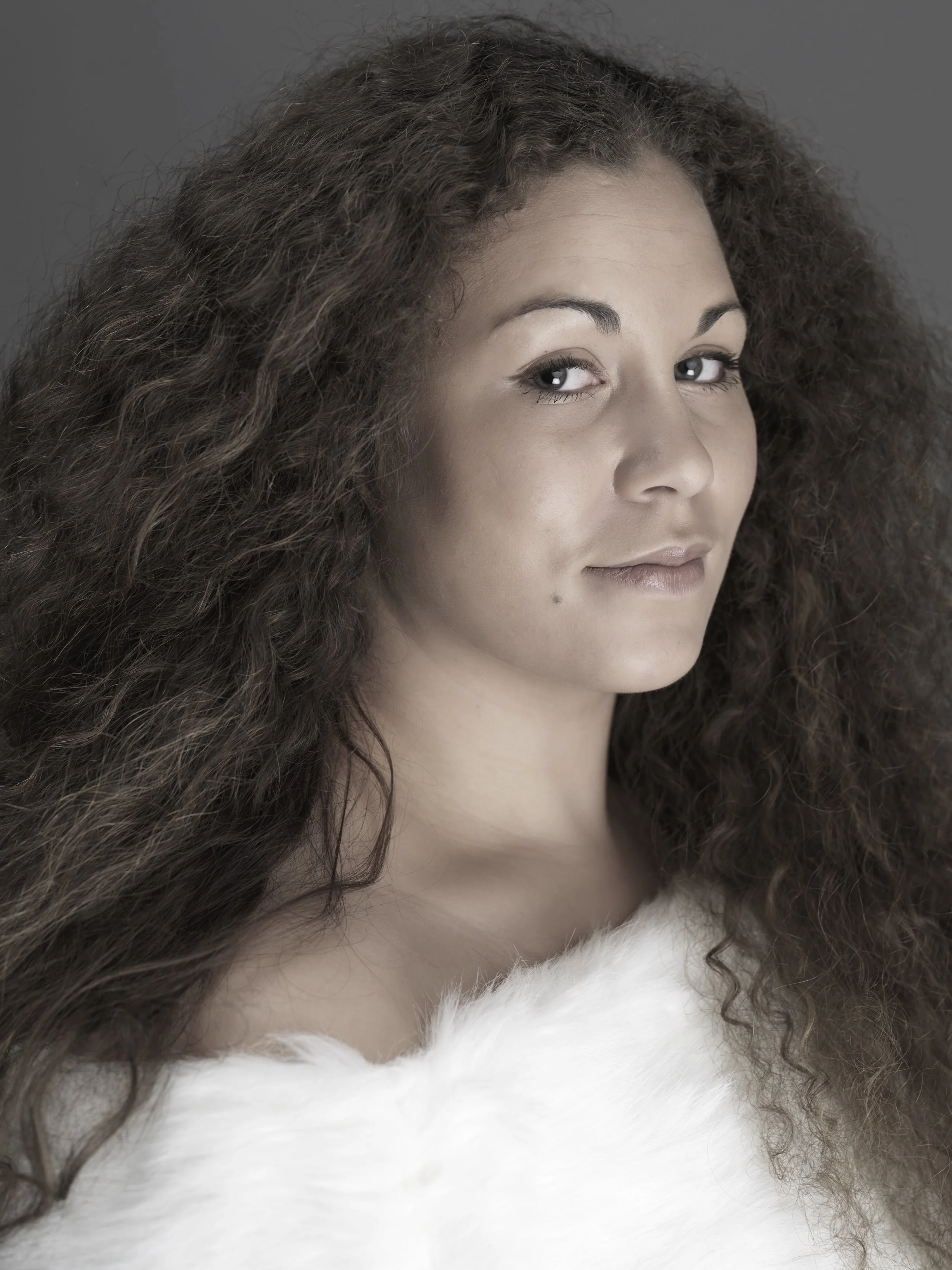
I am a Norwegian mezzo-soprano, performer and artistic creator, drawn to music as a place where stories, identities and human experiences can meet.
Singing has always been a place of refuge for me. As I have grown older, I have come to understand it as something more:
the place where I am most myself.
Growing up mixed-race in a predominantly white society shaped my understanding of identity and belonging, and inevitably my musical journey. My parents introduced me to an abundance of musical genres, all of which continue to inform the artist I am today. But it was seeing Carmen with my mother at the age of six that sealed my relationship with opera. I remember sitting on the edge of my seat as Carmen declared, “Libre elle est née et libre elle mourra.” I thought she was the coolest thing I had ever seen.
I knew I wanted to do exactly that.
STORYTELLING AND THE HUMAN EXPERIANCE
At the heart of my work is a love of storytelling. Whether inhabiting the complexity of an operatic character, exploring the intimacy of art song, or creating my own projects, I am interested in what happens when music allows us to see another human being more clearly.
Opera gives me the opportunity to step into another existence — to explore unfamiliar ways of thinking and feeling, and to search for what connects us. However extreme a character or story may seem, beneath it lies something profoundly human.
Roles such as Azucena, Amneris and Santuzza have allowed me to explore grief, love, jealousy, dignity, rage and vulnerability, and to find compassion for people who may at first seem very distant from me. And now, returning to Carmen, I find myself meeting again the woman who captivated me at six — discovering who she has become to me and what I can bring to a character interpreted by generations of artists before me.
CURIOSITY, BELONGING
AND AN EXPANDING TRADITION
Since my student years, I have been drawn to lesser-known repertoire and the less-travelled corners of the classical canon. Again and again, I found extraordinary music and wondered why so much of it remained unfamiliar.
It led me to questions that continue to drive my work: Whose stories are being told? Who gets to belong?
How do we honour tradition without allowing it to become static?
How can we expand our understanding of classical music and connect it to a wider community?
In searching for some of those answers, I met the late voice teacher and mentor Michael Harper, who had a profound impact on me both as a singer and as a human being. He introduced me to the vast and continually evolving tradition of classical music by composers of African descent.
For me, discovering this repertoire felt like a kind of homecoming. It became a musical space where different aspects of myself could exist together — where I could thrive, explore and grow as an artist.
That journey eventually became Singing for the Sake of My Soul, my ongoing exploration and celebration of music
by composers from the African diaspora.
AN INVITATION TO LISTEN
Ultimately, I want to invite audiences to be curious with me.
To encounter something unfamiliar. To hear something familiar differently.
To allow the human voice to awaken feelings we may not have known were there.
Music has given me insight, connection and a deeper understanding of both myself and others.
I believe that sharing that experience can create space for empathy — for leaning towards another person’s experience rather than away from it.
Classical music is not a closed chapter of our cultural history. It is a living tradition, continually expanding and evolving, and one that belongs to all of us.
When I sing, I am at my most vulnerable. To share that moment with another person — and feel them lean in —
is one of the most precious things I know.